
89% OFF! — WordPress Hosting, annual: €1.30/mo — 89% OFF! ... CLICK HERE! 89 % RABAT! — WordPress Webhotel, årligt: kr 9.10/md. — 89 % RABAT! ... KLIK HER! 89 % RABATT! — WordPress Webhotell, årlig: kr 14.20/mnd — 89 % RABATT! ... KLIKK HER! 89 % RABATT! — WordPress Webbhotell, årligen: kr 13.00/mån — 89 % RABATT! ... KLICKA HÄR! 89 % RABATT! — WordPress Hosting, jährlich: €1,30/Monat — 89 % RABATT! ... HIER KLICKEN! 89 % DE RÉDUCTION ! — Hébergement WordPress, annuel : 1,30 €/mois — 89 % DE RÉDUCTION ! ... CLIQUEZ ICI !
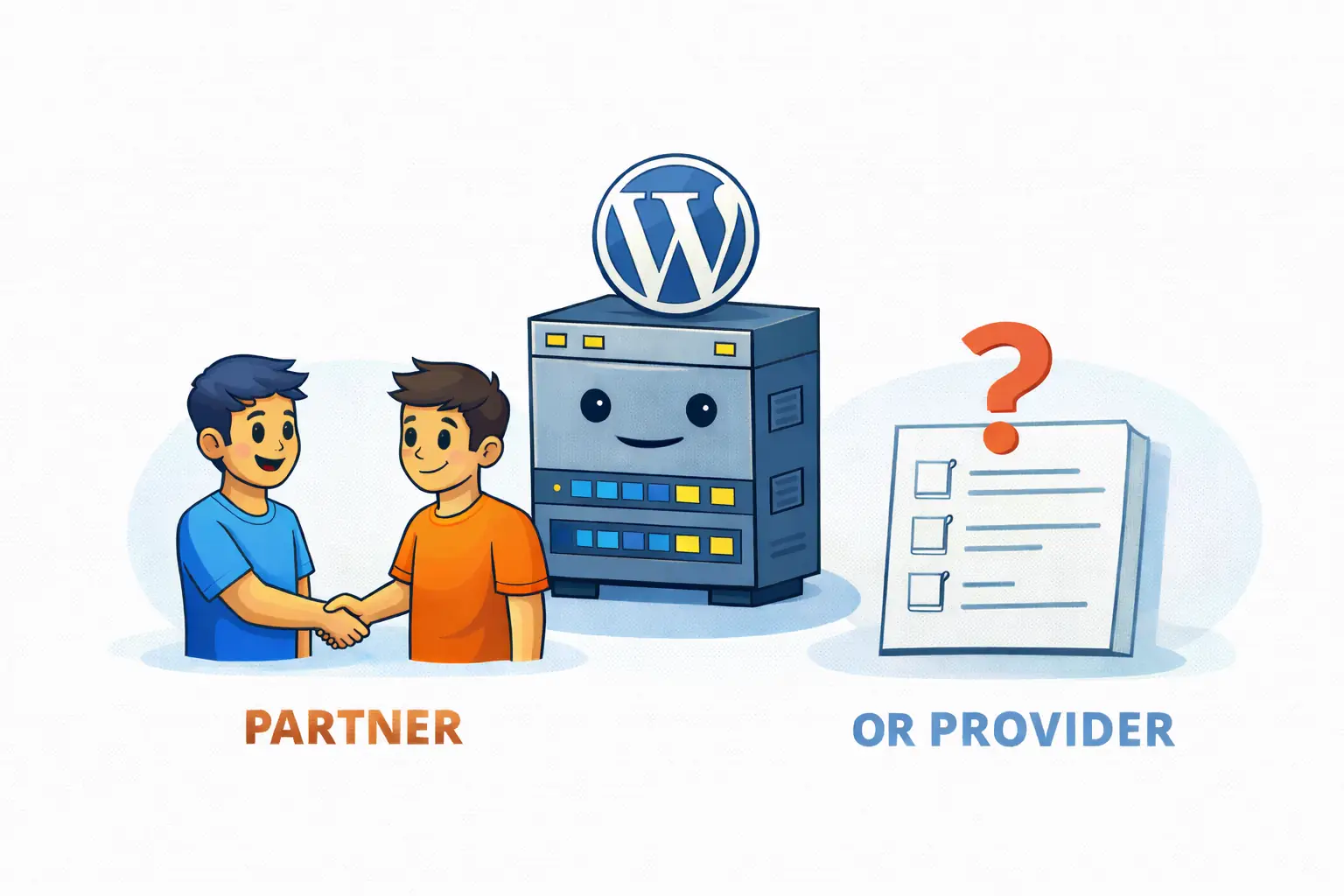
What’s the difference between a hosting provider and a hosting partner?
A hosting provider sells server space and features. A hosting partner takes responsibility for how WordPress runs, evolves, and recovers over time.
Why does this distinction matter for WordPress sites?
Because most WordPress problems are not caused by lack of disk space, but by fragmented responsibility, unclear ownership, and poor recovery paths.
Can hosting features replace good support and guidance?
No. Features help when everything works. A hosting partner helps when something breaks, updates fail, or growth creates uncertainty.
Is “all-in-one” hosting always better for WordPress?
Only if it reduces fragmentation and is designed specifically around WordPress workflows — not if it simply bundles unrelated services.
How do I know if I have a partner or just a provider?
If it’s unclear who owns the problem when something breaks, or if support only reacts instead of guiding, you likely have a provider — not a partner.
How to Choose a Hosting Partner (Not Just a Provider)
Most hosting companies describe themselves as providers.
They sell:
- storage
- bandwidth
- CPU time
- features
But WordPress sites don’t fail because they run out of disk space.
Based on patterns we see at WebQuickster, WordPress sites struggle when responsibility is fragmented — not when a feature is missing.
Providers Sell Resources. Partners Own Outcomes.
A hosting provider’s responsibility often ends at:
- “the server is online”
- “the service is available”
- “the feature exists”
A hosting partner looks further:
- Does the site feel stable?
- Are updates safe?
- Is recovery predictable?
- Does growth create confidence — not stress?
WordPress webhotel is not about access. It’s about outcomes over time.
Fragmentation Is the Real Enemy
Most hard-to-manage WordPress setups are not broken — they’re disconnected:
- domain in one place
- hosting in another
- email somewhere else
- backups via plugins
- security via add-ons
A partner’s job is to reduce fragmentation — not add more tools.
WebQuickster insight: WordPress becomes easier to manage when the platform is designed around the journey, not just the setup. When hosting, domains, email, backups, and support live in one flow, users stop feeling like system integrators — and start feeling like site owners again.
Why This Matters as You Grow
Early on, almost any hosting works.
As the site grows:
- more traffic
- more updates
- more integrations
- more at stake
That’s when the difference becomes visible.
Providers focus on uptime. Partners focus on continuity.
Final Thought
Choosing a WordPress webhotel is not about buying space.
It’s about choosing:
- who shares responsibility
- who reduces uncertainty
- who helps you grow without fear
A good hosting partner doesn’t make WordPress magical.
It makes WordPress predictable.